
Day Three: Karachi
The day started off with Gold Gate, which involved one of the travelers, who for anonymity purposes shall hereinafter be referred to as the Princess of Bäch. Said Princess, in an attempt to pay homage to Mansa Musa, unfortunately discovered that Uzbekistan has very strict gold export controls. She was duly found out by a customs agent, who probably believed he had rediscovered Yamashita’s Gold, and quickly became the focus of a 12-man investigation centred on a gold-linked chain that any aspiring rapper would envy.
After a long back-and-forth, and much to the relief of the Princess, we set off for Karachi. The flight took us over Afghanistan, which is, on the whole, not anyone’s first choice of overflight territory. A well-structured briefing, which any expert pilot would of course read beforehand, set out the relevant procedures. The most important of these could be summarised simply: under no circumstances was the plane to divert and land in Afghanistan. The briefing’s own phrasing was rather more direct. Should the worst happen, it offered simply… “Good luck with the Taliban.”
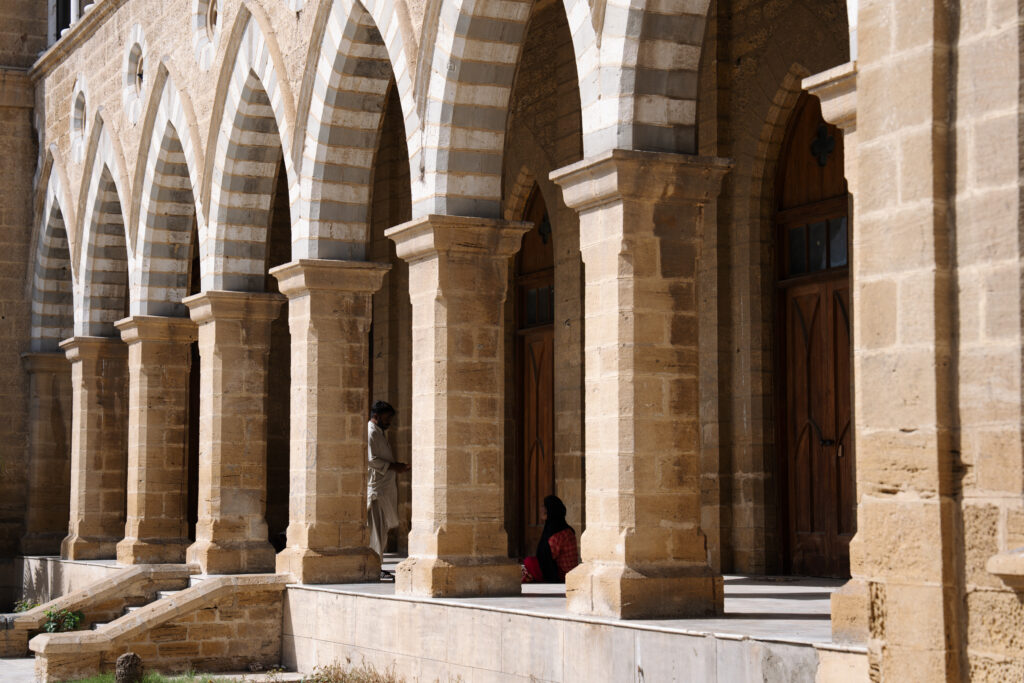
Finally in Karachi, we made our way into the city and started at Frere Hall, a Victorian-era library built in 1865 and named after Sir Bartle Frere, sitting in one of the few proper green pockets the city has left. From there we moved on to Mohatta Palace, built in 1927 for a Hindu Marwari businessman who left it behind at Partition and never came back. The result is pink Rajasthani stonework that looks as though it took a wrong turn out of Jodhpur. Dinner at Kolachi wrapped things up, out on the boardwalk at Do Darya, with the Arabian Sea on one side and Karachi on the other. A welcome close to a day that had begun at the Samarkand security check.
Karachi is the capital city of the province of Sindh, Pakistan. It is the largest city in Pakistan and 12th largest in the world, with a population of over 20 million. It is situated at the southern tip of the country along the Arabian Sea coast and formerly served as the country’s capital from 1947 to 1959. Ranked as a beta-global city, it is Pakistan’s premier industrial and financial centre. Karachi is considered Pakistan’s most cosmopolitan city, and among the country’s most linguistically, ethnically, and religiously diverse regions, as well as one of the country’s most progressive and socially liberal cities. Wikipedia
The region has been inhabited for millennia, but the city was formally founded as the fortified village of Kolachi as recently as 1729. The settlement greatly increased in importance with the arrival of the East India Company in the mid-19th century. British administrators embarked on substantial projects to transform the city into a major seaport, and connect it with the extensive railway network of the Indian subcontinent. At the time of Pakistan’s independence in 1947, the city was the largest in Sindh with an estimated population of 400,000 people. Following the partition of India, the city experienced a dramatic shift in population and demography with the arrival of hundreds of thousands of Muslim immigrants from India, coupled with an exodus of nearly all of its Hindu residents. Known as the “City of Lights” in the 1960s and 1970s for its vibrant nightlife, Karachi was beset by sharp ethnic, sectarian, and political conflict in the 1980s. The city had become well known for its high rates of violent crime, but recorded crimes sharply decreased following a crackdown operation initiated in 2013 by the Pakistan Rangers, dropping from being ranked the world’s 6th-most dangerous city for crime in 2014, to 128th by 2022. Wikipedia
Karachi collects 35% of Pakistan’s tax revenue, and generates approximately 25% of Pakistan’s entire GDP. Approximately 30% of Pakistani industrial output is from Karachi, while Karachi’s ports handle approximately 95% of Pakistan’s foreign trade. Approximately 90% of the multinational corporations and 100% of the banks operating in Pakistan are headquartered in Karachi. It also serves as a transport hub, and contains Pakistan’s two largest seaports, the Port of Karachi and Port Qasim, as well as Pakistan’s busiest airport, Jinnah International Airport. Karachi is also considered to be Pakistan’s fashion capital, and has hosted the annual Karachi Fashion Week since 2009. Wikipedia
Reference: Wikipedia.org under https://en.wikipedia.org/wiki/Karachi
Pakistan, officially the Islamic Republic of Pakistan, is a country in South Asia. It is the fifth-most populous country, with a population of over 241.5 million, having the second-largest Muslim population as of 2023. Islamabad is the nation’s capital, while Karachi is its largest city and financial centre. Pakistan is the 33rd-largest country by area. Bounded by the Arabian Sea on the south, the Gulf of Oman on the southwest, and the Sir Creek on the southeast, it shares land borders with India to the east; Afghanistan to the west; Iran to the southwest; and China to the northeast. It shares a maritime border with Oman in the Gulf of Oman, and is separated from Tajikistan in the northwest by Afghanistan’s narrow Wakhan Corridor. Wikipedia
Pakistan is the site of several ancient cultures, including the 8,500-year-old Neolithic site of Mehrgarh in Balochistan, the Indus Valley Civilisation of the Bronze Age, and the ancient Gandhara civilisation. Pakistan was brought into being at the time of the partition of British India in 1947, in response to the demands of Islamic nationalists: as articulated by the All India Muslim League under the leadership of Mohammed Ali Jinnah, India’s Muslims would receive just representation only in their own country. Since Pakistan and India achieved independence from British rule on August 14–15, 1947, celebrated as Independence Day, Pakistan has been distinguished from its larger southeastern neighbour by its overwhelmingly Muslim population. The 1971 civil war resulted in East Pakistan becoming the independent country of Bangladesh. Pakistan has since struggled throughout its existence to attain political stability and sustained social development, experiencing repeated military coups and ongoing tensions with India over the disputed region of Kashmir. WikipediaEncyclopedia Britannica
Pakistan is a developing country, and part of the Next Eleven, poised to become one of the world’s largest economies in the 21st century. The semi-industrialised economy is heavily dependent on agriculture, and industrial growth in Pakistan benefits significantly from agricultural expansion. As of 2025, Pakistan’s nominal GDP stood at US$410.5 billion, with GDP by PPP at US$1.67 trillion. The country encompasses a rich diversity of landscapes, starting in the northwest, from the soaring Pamirs and the Karakoram Range through a maze of mountain ranges, a complex of valleys, and inhospitable plateaus, down to the remarkably even surface of the fertile Indus River plain, which drains southward into the Arabian Sea. It contains a section of the ancient Silk Road and the Khyber Pass, the famous passageway that has brought outside influences into the otherwise isolated subcontinent. Lofty peaks such as K2 and Nanga Parbat, in the Pakistani-administered region of Kashmir, present a challenging lure to mountain climbers. WikipediaEncyclopedia Britannica
Reference: Wikipedia.org under https://en.wikipedia.org/wiki/Pakistan